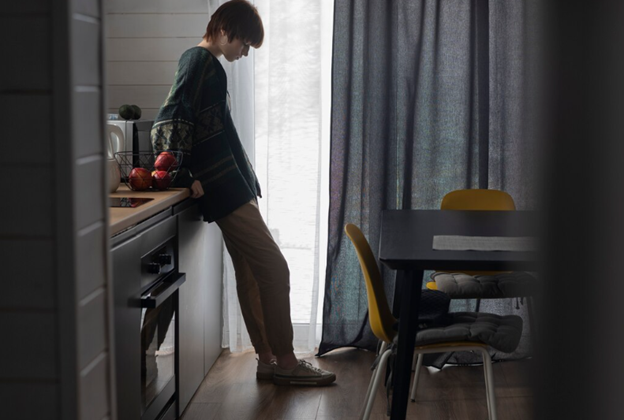
You’re standing in your kitchen. Coffee’s brewing. Nothing’s wrong. Then somewhere down the hall, a door slams — and your whole body jumps before your brain even catches up. Your pulse spikes. Your shoulders lock. For one full second, you’re bracing for something, anything, before a quieter voice finally says, that’s not my house. That’s not my life anymore. You laugh it off, maybe. You blame the coffee. But if you’re honest, this isn’t the first time your body has reacted like it’s still somewhere else — somewhere it needed to survive. Maybe you’ve always called this “being prepared.” Maybe people even compliment you for it — how observant you are, how you never get caught off guard. But what if that constant scanning isn’t a personality trait at all? What if it’s a trauma response your nervous system picked up a long time ago and never quite put down?
Let’s talk about what’s really happening underneath all that “readiness.”
The Room That Made This
Go back far enough, and there’s usually one image that explains everything, even if you’ve never said it out loud. Maybe it’s lying in bed as a kid, listening for tires in the driveway, cataloging which car door sound meant calm and which one meant you needed to disappear into your room. Maybe it’s learning to read the exact angle of someone’s shoulders from across a room — because that angle told you more than their words ever would. Maybe it’s simply knowing which floorboard creaked and avoiding it, every single night, even though no one ever taught you that.
You didn’t decide to notice these things. You just did, because noticing kept you safe. That’s the quiet architecture of an unpredictable childhood — you build an internal alarm system out of whatever raw material you have, and you get frighteningly good at using it.
The Quiet Lie Your Body Still Believes
Here’s the hinge point, the thing nobody says plainly enough: somewhere along the way, your nervous system decided that noticing everything was the price of staying alive. And it never got the memo that the danger ended.
That’s not a flaw. That’s a trauma response doing exactly what it built itself to do — just years past its expiration date. Your body isn’t broken; it’s loyal to an old job that never properly released it.
Where the Old Alarm Still Fires
In relationships
You catch yourself reading your partner’s tone before they’ve even finished their sentence. A slight pause on the phone, and you’re already three steps into “what did I do wrong,” even though nothing’s wrong at all.
In silence
Quiet should feel like relief. Instead, it feels like the air before something happens. You find yourself filling silence just so it stops feeling like a held breath.
In a room full of friends
You’re laughing, present, having a good time — and some part of you still knows exactly where the exit is. Always has. You never consciously check for it. You just already know.
None of this makes you dramatic or “too much.” It makes you someone whose fight-or-flight system never got the all-clear signal. Chronic anxiety like this doesn’t announce itself with a diagnosis — it just quietly runs your evenings.
The Turn: What You Notice, Not What You Fix
Here’s where it gets interesting — not because you finally “solve” it, but because you catch it in real time. One evening, someone you trust goes quiet for a beat too long, and your whole body starts gathering itself for impact. And then — nothing happens. You feel the bracing. You feel the old script loading. And for once, you don’t act on it. You just… let the moment pass through you instead of taking the wheel.
It’s not triumphant. Nobody claps. You don’t even tell anyone. But something shifts, quietly, in the noticing itself.
Living With the Contradiction
Let’s be honest about something most people skip: understanding your trauma response doesn’t switch it off. You can know exactly where this hyperawareness came from and still flinch at a slammed door next week. Emotional safety isn’t a finish line you cross once and never think about again.
The truth living underneath all of this is messier and more human — you can be someone who still scans every room for exits and someone who is genuinely, fundamentally okay. Both things live in the same body at once. Growing up in fear rewires you in ways that don’t fully rewrite themselves just because you’ve named them. What changes isn’t the wiring — it’s your relationship to it. The alarm still rings sometimes. You just don’t always answer.
A Body Finally Still
Tonight, maybe, you’re sitting in a quiet room. No door slams. No tires in the driveway. Just your own breath, slower than usual, filling a body that spent years bracing for something that never seems to come. You don’t need to explain it to anyone. You don’t need a lesson learned. You just sit there, still, for exactly as long as it lasts. And let that be enough.
If any of this feels familiar, you’re not alone, and stories like this one deserve someone willing to tell them all the way through. Read Out Of Their Dark Into My Light by Stephanie Snow Byrd — a raw, real account of surviving old wounds, relapsing, rebuilding, and choosing honesty daily. Grab your copy today and see healing in its true, unfiltered form.